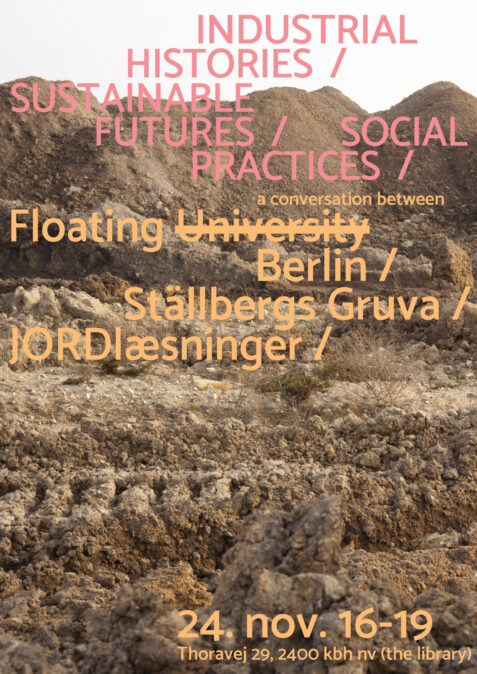
Testing Ground :
A conversation on industrial histories, sustainable futures and social practices
Join us on 24 November for an open conversation within and around the topics of industrial histories, sustainable futures and social practices between Ställbergs Gruva, Floating University Berlin and JORDlæsninger (SOILreadings).
Activists, cultural workers and artists has long occupied and inhabited old closed-down industries as ways to find an affordable framework for their activities. Emptied by their former function-value the sites give space to new interpretation and the often enormous sites give a feeling of unlimited space for testing ideas.
With an ambition to keep creating collective spaces for sharing and learning we look into how we can build sustainable futures on top of industrial histories through social practices. How are industrial sites shaping our practices and how are they helping us explore new directions, methods and ways of organizing?
The collectives invited works site-specifically in former industrial locations on longterm committed projects for a conversation on bringing different fields of knowledges together to explore views of nature, possible futures, politics, sciences and arts in relation to culture production from both a city-and a countryside perspective.
~
INFO
Testing Ground: A conversation on industrial histories, sustainable futures and social practices
Monday, 24 November 2025 at 4.00-7.00PM
Art Hub Copenhagen
Thoravej 29, in the library on 1st floor
2400 Copenhagen NV
It is free to attend, but please register via Billetto here.
After the conversation, we invite you to a joint dinner in Langar at Thoravej 29 from 7-9.00PM. The dinner consists of a meal and one drink for 50 kr. The ticket can be purchased here.
~
ABOUT SOILreadings
SOILreadings is a project initiated by artists Bodil Krogh Andersen & Martin-Christoffer Lund and is a part of a Testing Ground residency program at Art Hub Copenhagen, in which they will explore how to work with different learning and co-creation formats to form the basis of a future interdisciplinary summer school.
Based on an extensive focus on the Nordhavnen land-reclamation project and the migrating ecologies that simultaneously shape the area into recreational environments and bear witness to heavy industry, SOILreadings want to create spaces that facilitate collective investigations of the intertwined context.
The project has a particular focus on juxtaposing human conditions with the natural consequences of urban political ambitions, and on examining the city’s view of nature, the cultural history of materials, heavy industries, and local self-organized struggles.The aim is to find entry points for co-creation, not only across people with different experiences and backgrounds, but also the stories found in materials, residues of the building industry and species in the area, to encourage cohesion and edification in future sustainable ecosystems.
ABOUT STÄLLBERGS GRUVA
Ställbergs Gruva aims to be a place where the big questions become personal – and the personal becomes part of the big questions. A place for learning, doubt, and the living. Collective and individual. Existential and political. A place where outer space and world markets lean in together with the soil and worms and roots, and the echoes of human voices in an old machine room. Ställbergs gruva is run by the business association The non existent Center, and is based in an abandoned iron ore mine in Ställberg. The activities at Ställbergs gruva take place in a probing agonism and agreement, and is based in an openness to all living things, history, and our common ground. These activities – whether they are a choir, a publication, or a conversation at the Nittälven shore – can be described as artistic social inquiry. These inquiries take their starting point in a curiosity to understand, and a will to find common ground in a large and unfathomable world, or in feelings of anger, powerlessness and concern. The group often works with common questions and methods, starting in the local surroundings with its economic, social and ecological conditions. Examples of questions are: what kind of knowledge do we need in a world where the climate is changing fast? How can we learn together? Owning the site is a long-term commitment with an installment plan until the year 2070.
ABOUT FLOATING UNIVERSITY BERLIN
Floating University Berlin: a self-organised natureculture-learning site located within an overgrown and contaminated rainwater retention basin in the heart of Berlin, Germany, where practitioners from a wide range of backgrounds meet to collaborate, co-create and imaginatively work towards possible futures alongside a wetland ecosystem. On the site of the Floating University, the rainwater retention basin serving the former Tempelhof airport, a variety of animals, plants and algae have settled. A unique landscape has emerged: a human-made environment reclaimed by nature, where polluted water coexists with the relatively new presence of Floating University’s temporary architecture and program, forming a natureculture site (Haraway) or a third landscape (Clément).Since 2018, Floating University Berlin has been an inner-city laboratory for collective, experiential learning and transdisciplinary exchange. Our mission is to open, maintain and take care of this unique site while bringing non-disciplinary and collaborative programs to the public. It is a place to learn about and experiment with ecology, social equity and new ways of collectively imagining the city. A place to learn to engage, to embrace complexity, to navigate the entanglements of the world, to imagine and create different forms of living.