SPARK
The art-science collaborative programme SPARK is launched in collaboration with the Globe Institute at the University of Copenhagen. The initiative aims to foster meaningful exchanges between artistic and scientific practices, encouraging joint exploration of the big questions that shape our understanding of life, health, and the environment.

The programme is focused on supporting artistic outputs emerging from art–science duos. Each project team consists of at least one artist and one Globe Institute scientist.
The programme provides support for artists to partner with a Globe scientist for a year to realise a joint artistic project. The culmination of this process will be an artistic output developed through the collaboration between the artists and their scientific partners. The collective outputs will benefit from the curatorial expertise at Art Hub Copenhagen, forming a public presentation of the work at the conclusion of the program period.
~
Applications to the SPARK programme were invited through an open call, after which a jury composed of representatives from Art Hub Copenhagen and the Globe Institute, as well as two external experts from the art–science field, reviewed the submissions. The selection was based on the quality of the project idea, the strength of the collaboration, and its potential for public engagement.
Click on the titles below to view the project descriptions and read the jury statements for each group.
Artists
SONJA STRANGE & BARBARA AMALIE SKOVMAND
Researcher
ADRIEN HOUGE
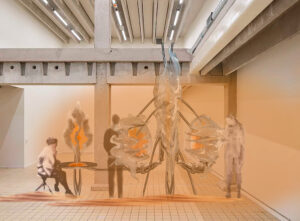
PLANETARY DUST MACHINE – FROM DUST YOU CAME, FROM DUST YOU SHALL REMAIN
Earth’s story begins with a single dust grain, a leftover from a newborn star. Colliding and sticking, these grains grew into pebbles that spiralled inward toward their star, carrying water ice and organic molecules that eventually accumulated into planets like Earth. We wish to build an installation with a performing dust machine that visualises Dr. Houge’s research in a concrete and poetic manner. It will be a sensuous machine that blends sound and visuals to bring this cosmic story to life.
Jury Statement
Planetary Dust Machine invites us to gather around planetary formation. From dust drifting across the cosmos to the lonely radiowave echoes of gathering pebbles, the work bridges scale and space inviting us to participate with the artist and the scientist in an installation that reflects the sounds and physicality of planetary creation. The jury was compelled by the project’s ambition to humanise the shape, scale and sounds of abstract processes in space.
Artists
EMMA HARRIS & LI LINDBLOM
Researcher
GIULIA ZAMPIROLO
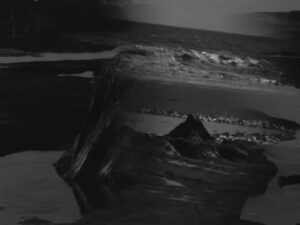
TIDAL FRAGMENTS – TRANSFORMATIONS OF MARINE LIFE ACROSS DEEP TIME
Tidal Fragments is an art-science collaboration that transforms microscopic fragments of ancient marine life and their invisible ecological histories into perceptible form. Working with ancient environmental DNA of seagrass, phytoplankton and bacteria preserved in marine sediments from the Kattegat, it explores deep-time transformations of marine ecosystems and how species, humans and coastal environments have evolved together over millennia. Through shared laboratory and studio experimentation, these traces are translated into an immersive sensory installation using analogue film and sand-casted sculptural forms, connecting ancient marine ecologies with the rapid changes unfolding in today’s oceans.
Jury Statement
Tidal Fragments proposes to transforms microscopic fragments of ancient marine life into an immersive sensory installation that makes invisible ecological histories perceptible to human perception. The jury was especially excited about the project’s well-planned transdisciplinary collaboration across laboratory and studio, for example in working with the materiality of the film strip to uncover new parallels between cinematic techniques and laboratory processes.
Artist
ZOE LOHMANN
Researcher
ALESSANDRO MEREGHETTI
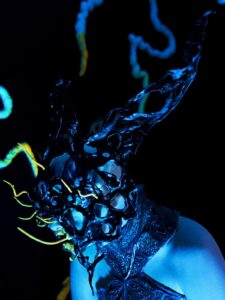
KEYSTONE
Keystone is a collaborative project between celebrating trailblazers in nature and culture alike. Inspired by Alessandro’s work studying the effect of megafauna on vegetation and its legacy after extinction, Keystone is an artistic response by drag and theatre artist Zoe Lohmann that draws a parallel to the legacy of queer innovation in major cultural revolutions. Who are the building blocks that keep an ecosystem or society alive and thriving? Is the ensuing collapse/extinction inevitable? What legacy is left behind, and how do we rebuild? At a time when we are witnessing the collapse of ecosystems all around us, as well as cultural and political shifts erasing queer visibility & legacy, these questions feel not only relevant but urgent.
Jury Statement
Keystone is a collaborative project that engages concepts of legacy and trailblazing across genetic and cultural evolutions. The jury was compelled by the proposal of the visual references of Alessandro Mereghetti’s research function as aesthetic anchors for Zoe Lohmann’s design of a hand-made sculptural garment for performance. Bold, ambitious and innovative, the jury found the project itself to be a trailblazer for art and science collaboration.
Artist
KIRSTINE AUTZEN
Researcher
ANA PROHASKA
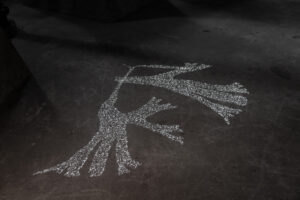
ALL THE SOFT ALWAYS GOES AWAY
In All the Soft Always Goes Away, artist Kirstine Autzen takes ancient pollen as a minuscule starting point with a potential to tell a much larger story of deep time, evolution and ecological fragility. From the pollen grain, the project will expand outwards to include the reproductive cycle of trees, forested landscapes where pollen is found, sedimentary archives, and the science environment at The Globe Institute. The project is made with inspiration from and in sustained dialogue with the researchers of Mass Flow – Reproduction in a Warming World: Assessing Adaptability of Mass Flowering to Climate Change led by Ana Prohaska.
Jury Statement
All the Soft Always Goes Away invites us to explore ancient pollen as a minuscule starting point from which we can enter a much larger story of deep time, evolution and ecological fragility. Autzen and Prohaska proposes a methodological exchange that stems from a shared interest in scientific imaging and in working methods informed by experiment and intuition. The jury was convinced by the potential in using imaging to visualize phenomena across scales and by the truly transdisciplinary collaboration.