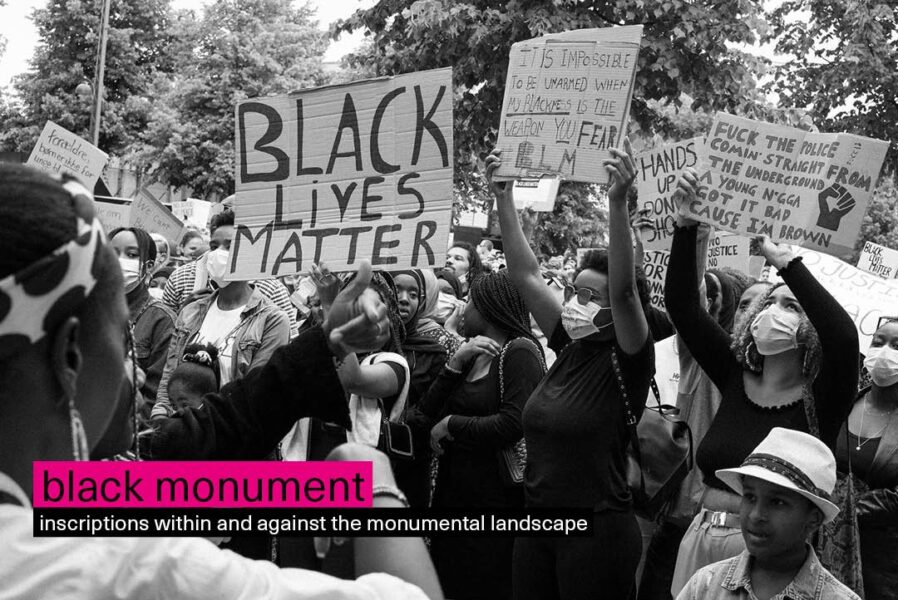
 Photo: Black Lives Matter protestors in Copenhagen on June 7, 2020, by Tobias Nilsson.
Seminar and Book Launch - black monument: inscriptions within and against the monumental landscape
Join us for the seminar and book launch black monument: inscriptions within and against the monumental landscape, on 5 March 2026!
The seminar, organized by G/HOSTING with Moving Monuments (UCPH) and Art Hub Copenhagen, explores the tensions between the Eurocentric monument tradition and radical black thought and liberation practices.
How do radical black thought, black communities, and black liberatory practices challenge colonial monumentality and its promotion of permanence, the nation-state, and liberal subjectivity? What artistic and curatorial strategies arise from this tension to rethink, reshape, and transgress the monument? Can black commemoration practices that refuse colonial frames of public memory reshape our visions of the monumental landscape of the future?
The seminar will conclude with a celebratory launch of the anthology black monument (AHC and Archive Books) edited by G/HOSTING, accompanied by a live DJ set by Santiago Mostyn.
~
INFO
Seminar and Book Launch
black monument: inscriptions within and against the monumental landscape
5 March, 2026
12.30–18.30
PROGRAM
12.30-13.00 Arrival : Coffee will be served
12.40-13.00 Sound piece Albertina and display of the visual artwork Do you remember Alberta Viola Roberts aka Alberta Cornelins (1901–1917)? by Justin F. Kennedy, Balz Isler, Ethan Braun featuring Natalie Hollins, Shannon Funchess & La Vaughn Belle.
13.00-13.25 G/HOSTING, Art Hub Copenhagen, Moving Monuments: Welcome
13.25-13.50 Elizabeth Löwe Hunter : 'Afrofeminist Analysis as an Anticolonial Method'
13.50-14.00 Q&A with Elizabeth Löwe Hunter
14.00-14.30 Break: Coffee will be served
14.30-15.05 Olive Vassell : 'Who Controls Memory? Black Communities Remap Europe’s Public Space'
15.05-15.15 Q&A with Olive Vassell
15.15-15.45 Break : Coffee will be served
15.45-16.00 Tawanda Appiah : 'Unseating Colonial History – A Public Reading'
16.00-16.15 Screening of Language Against Identity by Santiago Mostyn
16.15-16.30 Santiago Mostyn : 'Master Narratives'
16.30-16.45 Q&A with Tawanda Appiah and Santiago Mostyn
16.45-17.00 G/HOSTING : Thank you for today
17.00-18.30 Reception and book launch : Wine will be served, possibility of purchasing black monument at a reduced price, DJ set by Santiago Mostyn
Attendance is free, but registration for the event is necessary. Register through this Billetto link.
~
Elizabeth Löwe Hunter: Afrofeminist Analysis as an Anticolonial Method
This presentation is an exploration of Danish mainstream representations of Victor Cornelins, who was taken at seven years old from the former Danish West Indies to Copenhagen to be displayed in a colonial exhibition in Tivoli amusement park along with four-year-old Alberta Viola Roberts. It is a critical examination of the canonization of him as exceptional and of how he chose to narrate his own story. I seek first and foremost to read his story through a lens that recognizes his human experience, especially as a small child. Remembering the pain of colonial Black-child subjects with care, I am interested in their very human reactions to inhuman circumstances. I do this by reading about Cornelins’ lifelong experiences of racism as ordinary rather than spectacular and from a wish to disturb Danish public memory and insistence on white innocence. The presentation opens onto a discussion about the ways Cornelins and Roberts are un/remembered in Danish public space today.
Olive Vassell: Who Controls Memory? Black Communities Remap Europe’s Public Space
Europe’s black and brown communities have a long history of contribution to their home countries, but must navigate national, municipal, and cultural challenges in order to inscribe their presence in public space. They battle not just for acknowledgment, but for the authority to define collective remembrance. Black community actors have increasingly responded by disrupting bureaucracies around remembrance through varied commemoration practices, including public art interventions, temporary installations, counter-monuments and other forms of spatial storytelling, to challenge what is deemed worthy of permanence. Drawing on research from the anthology, Mapping Black Europe: Monument, Markers, Memories, this presentation interrogates community-led memorialization practices in eight European capital cities through a cross-national comparative lens. Grassroots acts of remembrance are the primary units of analysis, rather than state policies. Viewing country-specific acts of commemoration as interrelated pieces in a larger mnemonic ecosystem reveals the ways communities are not only remapping Europe’s historical terrain through removal or replacement of monuments, but also via prolonged, diffused practices of generating meaning that is reshaping public memory over time.
Tawanda Appiah: Unseating Colonial History – A Public Reading
On April 19, 2015, a red-armed crane lifted the statue of British imperialist and colonizer Cecil John Rhodes from its eighty-one-year-old perch at the University of Cape Town. In this historic moment, the inanimate object—fashioned from material extracted from the land—came to embody years of systemic violence inflicted upon the indigenous peoples of the African continent. The spectacle of its defacing, whipping, and eventual toppling symbolizes a call to action, drawing attention to the ubiquity of such monuments in contemporary society. In this reading, Tawanda Appiah speaks history into being, tracing its folds and fractures through language. He will begin with the Rhodes Must Fall Movement, pause at the Great Zimbabwe, and find his way to Malmö’s Torgbrunn. The reading is a live rendering of Appiah’s contribution to the anthology black monument (2026).
Santiago Mostyn: Master Narratives
Artists Susanna Marcus Jablonski and Santiago Mostyn are in the process of creating "Master Narratives," an anti-racist monument for the city of Malmö. In this presentation, Mostyn speaks about the background to the commission, how the work has evolved in dialogue with local activist groups, and the two halves of the artwork: a collective social memory process involving residents of Malmö, and the monumental stone and bronze sculpture that will be inaugurated later this year.
Justin F. Kennedy, Balz Isler, Ethan Braun featuring Natalie Hollins, Shannon Funchess & La Vaughn Belle: sound piece Albertina and visual artwork Do you remember Alberta Viola Roberts aka Alberta Cornelins (1901–1917)?
The image and sound piece created by Justin F. Kennedy and their collaborators appears in the anthology black monument (2026) as part of Justin F. Kennedy’s contribution Albertazine. Albertazine is written in the form of a script to a sci-fi opera following the story of the historical figure Alberta Viola Roberts. Alberta Roberts was abducted from the former Danish West Indies—today, the US Virgin Islands—at the age of four to be exhibited in Tivoli amusement park in Copenhagen in 1905 and passed away on March 31, 1917, the day Denmark transferred its Caribbean colony to the United States. In Albertazine, Alberta Viola Roberts is resurrected as a hyper-mythical figure, who haunts our present through a multitude of narratives, mediations, and personifications in the absence of physical memorial structures
Santiago Mostyn: Language Against Identity
Santiago Mostyn’s video workLanguage Against Identity (2024) traces the effects of geographic and cultural displacement by focusing on two case studies of animals that were forcibly taken away from southern Africa and put on display in northern Europe. The first is that of Bibi, a female elephant born in Zimbabwe in the mid-1980s, who was shipped to the GDR as a baby and still lives in captivity in Germany. The second is a museum collection of African birds housed in the small town of Vänersborg. The birds were captured by a Swedish settler in South West Africa in the late 1800s, and have been on continuous display for about 120 years. Language Against Identity contrasts the vibrant beauty of flora and fauna with the stark realities of colonialism and its dire, lasting effects (description by Tawanda Appiah).
~
The seminar features contributions by Olive Vassell (UK), Elizabeth Löwe Hunter (DK/US), Tawanda Appiah (Zim/SE), and Santiago Mostyn (TRI/US/SE).
ABOUT G/HOSTING
G/HOSTING is a Copenhagen-based platform, organized by Mai Takawira and Nina Cramer, that uses curatorial, editorial, educational, and dissemination projects to activate critical and reparative approaches to ongoing colonial histories. Through collaborations with artists, writers, and cultural institutions, G/HOSTING facilitates interventions into exhibitions, collections, public spaces, and academic discourses by foregrounding perspectives from the global majority. The anthology black monument (AHC, Archive Books, 2026) is G/HOSTING's first publication.
ABOUT MOVING MONUMENTS
Moving Monuments is a research project at the University of Copenhagen, organized by Mathias Danbolt and Amalie Skovmøller, that examines the aesthetic lives of monumental sculpture in the context of Danish colonial history. Working from the premise that sculptural monuments are dynamic historical agents whose functions and contexts change across time and space, the project examines the intersections of art, power, and imperial history.
ABOUT BLACK MONUMENT
black monument explores how artists and communities across Europe, North America, the Caribbean, and Southern Africa disrupt colonial monumentality. Featuring contributions from artists Justin F. Kennedy, Olivier Marboeuf, Jeannette Ehlers, patricia kaersenhout, and Abdul Dube alongside art historian Amelia Groom, black feminist scholars Lena Sawyer and Nana Osei-Kofi, and curator Tawanda Appiah, this anthology centers metamonumental practices—critical, sometimes speculative, and often ephemeral practices that refuse linear chronology and other Eurocentric frameworks.
Against the backdrop of renewed power struggles over monumental landscapes and ongoing racial injustice, black monument asks: What forms of care for black histories emerge in the absence of sanctioned monuments?
ABOUT ELIZABETH LÖWE HUNTER
Elizabeth Löwe Hunter is an independent researcher, writer, and cultural analyst. She examines racialization, belonging, national memory, and representation in Denmark. Hunter has taught antiracist research methods at UC Berkeley and consults organizations in intersectional data analysis and communication, e.g., in the educational and arts sectors. Hunter holds a Phd in Black Studies and Gender Studies from the University of California, Berkeley.
ABOUT OLIVE VASSELL
Olive Vassell is a journalist and professor who currently heads the Digital Media program at the University of the District of Columbia in Washington, D.C. Vassell is the co-editor of the anthology Mapping Black Europe: Monuments, Markers, Memories (2023) in which black scholars and activists across Europe highlight monuments, memorials, and urban markers to discuss collective narratives, outline community action, and introduce people and places relevant to Black European history, which continues to be obscured.
ABOUT TAWANDA APPIAH
Tawanda Appiah is a Zimbabwean curator, writer and researcher based in Malmö, Sweden. His research-centered practice often revisits history to make sense of the contemporary milieu. Appiah is the curator at Skånes Konstförening and was formerly the Curator of Education at the National Gallery of Zimbabwe. Appiah has curated several exhibitions, public programs and interventions including FLIGHT (Malmö Konsthall, 2023).
ABOUT SANTIAGO MOSTYN
Santiago Mostyn (b. Turtle Island) is an artist whose practice foregrounds narrative entanglements in pursuit of new understandings of place, with works manifesting as films, texts, exhibitions, and curatorial projects. Mostyn grew up in Zimbabwe and Trinidad, lives in Sweden, and was the 2024-25 Logie Fellow at the Harvard Radcliffe Institute.